Blog

  • The Art of Content Creation: A Story of Struggle, Breakthrough, and Victory

    The Art of Content Creation: A Story of Struggle, Breakthrough, and Victory

    Picture this: you’re sitting in your home office, staring at a blank document, much like Vincent Chase once stared at his reflection before his first Hollywood audition. The parallel between content creation and Hollywood stardom might seem far-fetched at first—after all, you’re not cruising around in a Ferrari or spending nights at exclusive parties (yet). But when you zoom out and look at the bigger picture, the journey from an anonymous content creator to a digital influencer mirrors Vincent Chase’s rise to fame in Entourage more than you might think. Let’s dive into this surprisingly educational and somewhat humorous parallel, shall we?

    The Humble Beginnings: When Nobody Knows Your Name

    Think back to when Vince was just another guy from Queens, armed with nothing but charm and a dream of making it big in Hollywood. For content creators, that’s exactly where most of us start—embarking on a journey with limited resources, no brand recognition, and little to show for all the late-night brainstorming sessions. You may have what you believe is the most groundbreaking idea since sliced bread made its Instagram debut, but like Vince’s early headshots, those ideas are sitting untouched in your drafts folder.

    The Psychology of Starting from Zero
    It’s crucial to understand why your initial content might flop—it’s not just bad luck; it’s the psychology of starting from ground zero. There are a few cognitive barriers both actors like Vince and content creators alike must overcome:

    The Imposter Syndrome Phase

    Much like Vince, who had to fight through self-doubt about whether he belonged in Hollywood, content creators often question whether they have the authority to speak on their chosen topics. This self-doubt can often manifest in several ways:

    • Overcompensating with excessive industry jargon to sound more authoritative
    • Mimicking successful creators instead of developing a unique voice
    • Hesitating to hit ‘publish’ on content you know could be a game-changer because you’re worried it might not be good enough

    The Dunning-Kruger Effect

    Like many newcomers in Hollywood, content creators can often suffer from a version of the Dunning-Kruger Effect. This occurs when you either underestimate the complexity of creating impactful content (just like Vince underestimated the intricacies of being a leading man) or, on the other hand, overanalyze it so much that it paralyzes you. It’s a fine line between overconfidence and overthinking. Both can hold you back from achieving greatness.

    The Strategic Evolution: Building Your Digital Entourage

    If Entourage taught us anything, aside from the fact that Ari Gold’s anger management issues would have gotten him fired in the real world, it’s that success often requires a strategic support system. Let’s break down your very own digital entourage and its key players.

    The Ari Gold Principle: Strategic Aggression in Content Creation

    Ari Gold was known for being aggressive, but it wasn’t blind aggression. He knew how to read the market and strategically position his client to ensure success. Similarly, your content strategy requires the same level of insight and precision.

    Market Intelligence Gathering

    Just as Ari always had his finger on Hollywood’s pulse, you need to have your finger on the pulse of your industry. Success in content creation doesn’t happen in a vacuum. You need to:

    • Understand Algorithm Patterns: For example, LinkedIn’s algorithm favors posts that generate quick engagement within the first hour, much like how opening weekend numbers can make or break a movie.
    • Conduct Competitive Analysis: Study your competition like Ari studied rival agencies. What content formats are they succeeding with? What topics generate the most engagement? What gaps in their content strategy can you exploit to create something unique?

    The Drama Factor: Emotional Intelligence in Content

    Johnny Drama’s character arc in Entourage offers valuable lessons on creating content that resonates emotionally with your audience. Drama’s journey teaches us that authenticity and emotional connection are the keys to standing out.

    The Authenticity Paradox

    Drama’s most successful moments came when he embraced his own quirks instead of trying to be like Vince. For content creators, this translates to:

    • Personal Voice Development: Instead of mimicking popular styles, focus on creating content that reflects your unique perspective and experiences. For instance, if you’re sharing financial content, your personal money mistakes might be more valuable to your audience than generic advice.

    Vulnerability as Strength

    One of Drama’s most memorable moments came when he was candid about his failures. Similarly, a software developer sharing their journey through a challenging project—warts and all—often creates more engaging content than a perfectly polished tutorial.

    The Breakthrough Moment: When Content Meets Opportunity

    Vince’s breakout role in Aquaman didn’t happen by accident; it was the culmination of preparation meeting opportunity. Similarly, your “Aquaman moment” will occur when all of the following elements fall into place:

    The Technical Mastery Phase

    The first step in creating your breakthrough content is mastering the platforms. Each social media platform is like a different movie genre—each with its own set of rules.

    Platform-Specific Excellence

    You wouldn’t approach a dramatic role the same way as a comedy, just as you shouldn’t approach LinkedIn the same way you approach TikTok. Here are some platform-specific strategies:

    • LinkedIn: The Drama Platform
      Focus on professional storytelling, sharing industry insights, and personal growth experiences while engaging with thought leaders in your field.
    • TikTok: The Action Movie Platform
      Quick, attention-grabbing hooks are essential. Fast-paced content and visual storytelling should dominate here.
    • Instagram: The Romantic Comedy Platform
      Focus on beautiful visuals combined with relatable content. Behind-the-scenes glimpses and lifestyle integration will build engagement.

    The Content Ecosystem Development

    Much like Vince’s success in Aquaman led to more opportunities, your breakthrough content should build an ecosystem of interconnected materials. Create content that can be repurposed across various platforms:

    • Long-form blog posts that break down into bite-sized social media snippets
    • Video content that generates quotable moments
    • Podcast episodes that generate supporting written content

    Advanced Content Strategies: The Empire-Building Phase

    Once you’ve had your breakthrough, it’s time to build your empire. The multi-season Entourage saga offers great lessons in this phase of content creation.

    The Multi-Platform Domination Strategy

    Like Vince branching into different film genres, successful content creators must master multiple platforms while maintaining consistency in their core message. This requires cross-platform storytelling, such as:

    • Instagram Stories: Offer behind-the-scenes glimpses
    • LinkedIn: Share in-depth industry analysis
    • Twitter: Engage in real-time thought leadership
    • YouTube: Deliver comprehensive tutorials and discussions

    The Innovation Imperative

    Vince took calculated risks with projects like Medellin—content creators must take similar risks to stay relevant. Consider experimenting with new content formats like:

    • Interactive content that directly engages your audience
    • User-generated content campaigns
    • Live streaming events and community-driven content initiatives

    The Sustainability Phase: Building Your Legacy

    As Entourage progressed, Vince and his entourage sustained their success through diversification and adaptation. Content creators must follow the same principles to keep their audience engaged over the long haul.

    Community Building and Engagement

    Like Vince’s loyal fanbase, you need to cultivate a dedicated community around your content. Create exclusive content for your most engaged followers, encourage two-way communication, and foster discussions within your audience. Celebrate their successes and contributions, making them feel like a part of the journey.

    Content Diversification

    Just as Vince eventually moved into directing and producing, successful content creators need to diversify their offerings. Expand your content portfolio by considering:

    • Premium content offerings such as paid guides, ebooks, or memberships
    • Online courses or webinars to share deeper knowledge
    • Writing ebooks or hosting virtual events

    The Future of Content Creation: Staying Ahead of the Curve

    As we look toward the future, content creators must remain as adaptable as Hollywood stars. This means embracing emerging technologies and keeping up with new platforms.

    Emerging Technologies and Platforms

    Stay ahead of trends by exploring:

    • AI-enhanced content creation tools
    • Virtual and augmented reality content
    • New social media platforms
    • Interactive content formats

    The Human Element in an AI World

    As technology evolves, the human touch will become even more valuable. Focus on authentic storytelling, building genuine connections, and maintaining transparency with your audience to stay ahead of the curve.

    The Final Take: Your Content Magnum Opus

    Much like Vincent Chase’s journey from an unknown actor in Queens to Hollywood royalty, your content creation journey is one of persistence, adaptation, and growth. Remember, even Vince had box office flops, but he never let them define his career. Similarly, your content journey will have its ups and downs, but it’s the overall trajectory that matters.

    As Ari Gold would likely say (with a few more expletives), “Success in this business isn’t about one hit wonder; it’s about building a legacy that makes people forget you were ever a nobody.”

    Ready to build your content empire? Let’s make some magic happen. And unlike Vince, you don’t need a million-dollar budget to get started—just a wifi connection and a dream. 🎬

  • From Alien Hunters to Click Masters: How ‘Predator’ Secretly Taught Us Digital Marketing

    From Alien Hunters to Click Masters: How ‘Predator’ Secretly Taught Us Digital Marketing

    In a world where marketing meets muscles, one movie inadvertently became the ultimate guide to digital dominance. Here’s how an 80s action classic can transform your marketing strategy faster than you can say “Get to the chopper!”

    “If it bleeds, we can kill it.” – Finding Your Competitive Edge

    Every marketer has faced that seemingly invincible competitor – the industry giant who appears to dominate every keyword, own every conversation, and capture every lead. But just as Dutch discovered the Predator’s weakness through careful observation, your path to success lies in methodical competitive analysis.

    Think of your market like the dense jungle of Val Verde. Your competitors may have impressive cloaking technology (or in marketing terms, massive budgets), but they can’t hide everything. Use tools like SEMrush, Ahrefs, or Moz to track their digital footprints. Look for:

    • Underserved customer segments they’ve overlooked
    • Keywords they’ve neglected
    • Content gaps in their strategy
    • Social media conversations they’re missing

    Remember, even Amazon started by focusing on books – a single weakness in the retail giants’ armor that they could exploit.

    “Get to the chopper!” – The Art of Agile Marketing

    In today’s fast-paced digital landscape, opportunity often arrives with the subtlety of a military helicopter in a jungle clearing. The ability to pivot quickly and capitalize on trending moments can mean the difference between viral success and digital obscurity.

    Consider Oreo’s famous “You can still dunk in the dark” Super Bowl blackout tweet or Aviation Gin’s lightning-fast response to Peloton’s controversial ad. These brands didn’t just get lucky – they were prepared. They had their choppers ready, so to speak.

    To master agile marketing:

    • Build a rapid-response team
    • Create pre-approved content templates
    • Establish clear approval processes
    • Monitor trending topics in real-time
    • Maintain a library of ready-to-deploy assets

    “I ain’t got time to bleed.” – The Power of Marketing Efficiency

    Just as Blain couldn’t let a little flesh wound slow him down, modern marketers can’t afford to waste time on ineffective strategies. In the digital jungle, efficiency isn’t just about saving resources – it’s about survival.

    Implement a robust analytics framework to track every aspect of your campaigns. Think of your marketing budget like ammunition – you can’t afford to waste it shooting at shadows. Use data to:

    • Identify top-performing channels
    • Optimize conversion paths
    • Eliminate underperforming campaigns
    • Focus resources on proven strategies
    • Automate repetitive tasks

    “There’s something out there waiting for us, and it ain’t no man.” – Embracing Emerging Technologies

    The marketing landscape is constantly evolving, with new technologies emerging like invisible predators in the night. From AI-powered analytics to voice search optimization, staying ahead means embracing these changes before they catch you off guard.

    Keep your eyes on emerging trends like:

    • Artificial Intelligence in personalization
    • Voice search optimization
    • Augmented Reality in customer experience
    • Blockchain in advertising transparency
    • Machine Learning in predictive analytics

    “We’re a rescue team, not assassins.” – Building Trust Through Value

    Your audience isn’t prey to be hunted – they’re people seeking solutions. Just as Dutch’s team had a noble mission (at least initially), your marketing should focus on providing genuine value rather than just pursuing conversions.

    Create content that:

    • Educates and empowers your audience
    • Solves real problems
    • Builds long-term relationships
    • Establishes thought leadership
    • Creates meaningful connections

    “What the hell are you?” – Understanding Your Audience at a Deeper Level

    Just as the team needed to understand their otherworldly opponent, marketers must develop a deep understanding of their audience. Surface-level demographics aren’t enough – you need to comprehend their motivations, behaviors, and pain points.

    Use tools and techniques like:

    • Customer journey mapping
    • Behavioral analytics
    • Social listening
    • Customer interviews
    • Heat mapping and session recording

    “Run! Go! Get to the chopper!” – Knowing When to Pivot

    Sometimes, the best strategy is knowing when to abandon ship. In marketing, this means having the courage to recognize when a campaign or strategy isn’t working and quickly redirecting resources to more promising opportunities.

    Develop clear criteria for:

    • Campaign performance thresholds
    • Resource allocation decisions
    • Risk assessment
    • Exit strategies
    • Alternative approach planning

    “Stick around.” – The Art of Retargeting

    In the digital world, getting someone to visit your site once isn’t enough. Like the Predator tracking its prey, you need to maintain contact with potential customers through strategic retargeting.

    Implement sophisticated retargeting through:

    • Dynamic product ads
    • Custom audience segmentation
    • Cross-platform remarketing
    • Sequential messaging
    • Behavioral triggers

    “He didn’t disappear. He was skinned alive!” – Learning from Competitive Analysis

    Your competitors’ successes and failures are valuable intelligence. Study them carefully, not to copy their strategies, but to learn from their experiences and identify opportunities they might have missed.

    Focus your competitive analysis on:

    • Content strategy evaluation
    • Social media engagement patterns
    • Customer feedback and reviews
    • Marketing channel effectiveness
    • Brand positioning and messaging

    “You’re one ugly motherf**ker.” – Embracing Authentic Branding

    In a world of polished corporate messaging, sometimes the most effective approach is raw authenticity. Don’t be afraid to let your brand’s unique personality shine through, even if it means being a bit unconventional.

    Remember:

    • Authentic voices stand out
    • Personality creates connection
    • Distinctiveness drives memorability
    • Bold messaging captures attention
    • Genuine communication builds trust

    The Final Showdown: Your Marketing Victory

    Just as Dutch emerged victorious from his jungle encounter, your marketing can triumph in the digital landscape. The key is to combine strategic thinking with swift execution, always staying one step ahead of both competitors and market changes.

    Remember, in the end, it’s not about having the biggest budget or the most sophisticated tools. It’s about understanding your environment, knowing your audience, and being ready to adapt when the situation demands it.

    Now, get out there and start hunting for your marketing success. Just remember to leave the thermal vision and shoulder-mounted plasma caster at home – Google Analytics will do just fine.

  • Building Exceptional Teams and Leading with Purpose: A Project Manager’s Guide to Success

    Building Exceptional Teams and Leading with Purpose: A Project Manager’s Guide to Success

    Let’s cut through the noise and get straight to the heart of the matter: project management isn’t just about timelines, budgets, and deliverables. It’s about people. It’s about building teams that work together seamlessly and leading them with clarity and purpose. If you want to excel in your project management career—and ace that PMP exam—you need to master the art of team building and leadership.

    This isn’t just fluffy advice. It’s the foundation of every successful project. So, let’s break it down step by step, with actionable insights and resources to help you along the way.


    The Foundation: Building a Cohesive Team

    A project is only as strong as the team behind it. But building a team isn’t about throwing together a group of skilled individuals and hoping for the best. It’s about creating a unit that collaborates effectively, trusts one another, and is aligned around a common goal.

    Here’s how you do it:

    1. Foster Collaboration: Encourage open communication and break down silos. A team that works together thrives together.
    2. Build Trust: Trust is the glue that holds a team together. Be transparent, keep your promises, and create an environment where everyone feels valued.
    3. Align Around Shared Goals: Make sure every team member understands the project’s objectives and their role in achieving them. Clarity is key.

    But here’s the thing: team building isn’t a one-time event. It’s an ongoing process. If you’re looking to dive deeper into this topic, check out this Introduction to Team Building and Leadership. It’s a great starting point for understanding the dynamics of high-performing teams.


    The Art of Leadership: More Than Just Direction

    Leadership in project management isn’t about barking orders or micromanaging every detail. It’s about inspiring your team, guiding them through challenges, and keeping them focused on the end goal.

    To lead effectively, you need to:

    • Set Clear, Achievable Goals: Your team needs to know what success looks like. Break down the project into manageable milestones and communicate them clearly.
    • Master Communication: This isn’t just about talking; it’s about listening. Understand your team’s needs, address their concerns, and keep everyone informed.
    • Leverage Emotional Intelligence: Great leaders understand their team members on a deeper level. What motivates them? What stresses them out? Use this knowledge to guide and support them.

    Leadership is a skill that requires continuous improvement. For more insights, explore Microsoft’s Team Building and Leadership Strategies. It’s a treasure trove of practical advice for project managers looking to up their game.


    Empowering Your Team and Engaging Stakeholders

    Empowerment isn’t just a buzzword—it’s a critical component of successful project management. When team members feel empowered, they take ownership of their work, make better decisions, and contribute more effectively to the project’s success.

    Here’s how to empower your team:

    1. Delegate Decision-Making: Trust your team to make the right calls. Give them the autonomy to solve problems and take initiative.
    2. Leverage Strengths and Diversity: Every team member brings something unique to the table. Use those strengths to your advantage.
    3. Encourage Feedback: Create a culture where feedback is welcomed and acted upon. It’s a powerful tool for growth and improvement.

    And let’s not forget about stakeholders. Keeping them engaged and informed is just as important as managing your team. Regular updates, clear communication, and a proactive approach to addressing concerns will ensure their support throughout the project.


    The Big Picture: Why This Matters

    At the end of the day, project management is about delivering results. But those results don’t come from spreadsheets or software—they come from people. By building a cohesive team, leading with purpose, and empowering everyone involved, you set the stage for success.

    Here’s the bottom line:

    • Team Building: Collaboration, trust, and shared goals are the foundation of every high-performing team.
    • Leadership: Inspire, communicate, and use emotional intelligence to guide your team through challenges.
    • Empowerment and Engagement: Give your team the tools they need to succeed and keep stakeholders invested in the project’s success.

    This isn’t just about passing the PMP exam or checking boxes on a project plan. It’s about creating an environment where people can do their best work and achieve extraordinary results.


    Your Next Steps

    Ready to take your team-building and leadership skills to the next level? Start with these resources:

    Remember, this is a journey, not a destination. Keep learning, keep growing, and keep building teams that can tackle any challenge.

    Now, go out there and lead like the project management pro you are. Your team—and your stakeholders—are counting on you.

  • How to Use Blogging to Rank #1 on Google: A Masterclass in SEO and Content Strategy

    How to Use Blogging to Rank #1 on Google: A Masterclass in SEO and Content Strategy

    By Samuel Parker


    Introduction: The Power of Blogging in HubSpot’s and Saleforce’s Success

    If you’ve ever wondered how HubSpot and Salesforce dominate Google’s search results, you’re in the right place. Blogging isn’t just a side hustle for us—it’s the backbone of our traffic generation strategy. A significant percentage of HubSpot and Salesforce customers first discovered us through our blog. They Googled a question, and clicked on one of our posts, and the rest is history.

    But how does blogging work its magic? And how can YOU use it to drive traffic, generate leads, and grow your business? Let’s dive in.


    Why Blogging Works: Relevance and Authority

    Blogging isn’t just about churning out content. It’s about building relevance and authority. Every time you publish a blog post, you’re adding another indexed page to your website. This means:

    • More Opportunities to Rank: Each post is a new chance to appear in search results.
    • Fresh Signals to Google: Regular updates tell search engines your site is active and worth crawling.

    But blogging isn’t just about search engines. It’s also about creating shareable content. Every post you write is potential fuel for social media, driving traffic and boosting your SEO.


    Smart Pro’s Secret Sauce: 3 Key Tactics

    At Smart Professional Content, we’ve honed our blogging strategy to perfection. Here are the three major tactics that have transformed our SEO game:

    1. Building Topical Relevance
    2. Optimizing for Featured Snippets
    3. Historical Optimization

    Let’s break each one down.


    1. Building Topical Relevance: From Keywords to Topics

    Gone are the days of stuffing blog posts with keywords. Today, it’s all about topics.

    • Keyword vs. Topic: A keyword is a single search term (e.g., “writing skills”). A topic is a cluster of related keywords (e.g., “content marketing”).
    • Why It Matters: Google’s algorithms have evolved. They now understand the context behind searches, not just individual keywords.

    How We Do It:

    1. Identify the topics we want to own (e.g., “customer service”).
    2. Publish blog posts that answer every possible question about those topics.
    3. Link related posts together to build authority.

    For example, before Salesforce and Hubspot launched their customer service software, they created a pillar page on “customer feedback” and linked it to dozens of supporting blog posts. The result? They ranked on the first page of Google for five out of ten target topics—before the product even launched.


    2. Optimizing for Featured Snippets: The Holy Grail of SEO

    Featured snippets are the answers that appear at the top of Google’s search results. They’re like SEO gold—because they appear above the #1 organic result.

    Why You Should Care:

    • Increased CTR: Featured snippets can boost your click-through rate by over 114%.
    • Voice Search Dominance: 71% of voice search results come from featured snippets.

    How to Optimize:

    1. Identify posts ranking in the top 5 for high-volume keywords.
    2. Format your content for snippets:
      • Use clear headers (H2, H3).
      • Write concise answers (50-58 words).
      • Include lists or steps where relevant.
    3. Submit updated URLs to Google for re-crawling.

    At HubSpot, we’ve seen massive traffic spikes by optimizing for snippets. For example, cleaning up header formatting in list posts increased our snippet win rate by 10-15%.


    3. Historical Optimization: Breathing New Life into Old Posts

    Why write new content when you can make your old posts work harder? That’s the philosophy behind historical optimization.

    What It Is: Updating and republishing old blog posts to improve their search rankings.

    Why It Works:

    • Freshness: Google loves up-to-date content.
    • Existing Authority: Older posts already have some SEO juice.
    • New Links and Shares: Repromoting updated posts can attract new backlinks.

    How We Do It:

    1. Identify high-traffic posts ranking on page 2 or 3.
    2. Update the content for accuracy, freshness, and comprehensiveness.
    3. Republish with a new date and promote like a new post.

    The results? In the first nine months of implementing this strategy, we doubled the monthly leads generated by old posts and increased organic traffic by 106%.


    Visualizing the Strategy: Diagrams and Illustrations

    To help you understand these concepts better, here are some visuals:

    1. Topical Relevance Framework
      Topical Relevance Diagram
      A visual representation of how pillar pages and supporting blog posts interlink to build authority.
    2. Featured Snippet Optimization
      Featured Snippet Flowchart
      Step-by-step guide to optimizing content for featured snippets.
    3. Historical Optimization Process
      Historical Optimization Infographic
      How to identify, update, and republish old posts for maximum impact.

    Conclusion: Blogging as a Growth Engine

    Blogging isn’t just a marketing tactic—it’s a growth engine. By building topical relevance, optimizing for featured snippets, and leveraging historical optimization, you can turn your blog into a traffic-generating powerhouse.

    At HubSpot and Salesforce, we’ve seen firsthand how these strategies can transform SEO performance. And the best part? They’re repeatable. Whether you’re a startup or an established brand, these tactics can work for you.

    So, what are you waiting for? Start blogging like a pro, and watch your rankings soar.


    Additional Resources:


    Featured Image: Blogging for SEO
    Caption: Blogging isn’t just about writing—it’s about strategy, relevance, and authority.


  • The Psychology and Art of Modern Blog Writing: A Comprehensive Guide

    The Psychology and Art of Modern Blog Writing: A Comprehensive Guide

    Here’s an ironic truth: In the time it takes to read this comprehensive guide about writing engaging blog posts, dozens of readers will have already clicked away from partially read articles. But for those committed to mastering the craft of digital storytelling, this deep dive into the psychology and mechanics of compelling content will be worth every minute.

    The Modern Attention Economy: Understanding Our Challenge

    In our hyperconnected world, attention has become the most precious commodity. Every day, millions of blog posts compete for a finite resource: human attention spans that have dwindled to mere seconds. The challenge isn’t just writing good content—it’s crafting content that can pierce through the noise and capture the increasingly elusive focus of our readers.

    The Sobering Statistics

    Consider this paradox: While more content is being produced than ever before—over 7.5 million blog posts daily—readers are spending less time engaging with each piece. Research shows that 43% of readers admit to skimming blog posts, while only 16% read word-for-word. This creates a fascinating challenge for content creators: How do we write for both the skimmers and the deep divers?

    The Psychology Behind Engaging Content

    Understanding the psychological principles that drive reader engagement is crucial for creating content that resonates. Let’s explore the cognitive mechanisms that determine whether a reader stays or strays.

    The Cognitive Load Theory

    Our brains are constantly working to conserve energy, making split-second decisions about what deserves our attention. This biological imperative means readers are subconsciously asking themselves three questions within the first few seconds of encountering your content:

    1. Is this relevant to my needs?
    2. Will the effort required to read this be worth the reward?
    3. Can I trust this source to deliver value?

    The Dopamine Factor

    Engaging content triggers dopamine releases in the brain through:

    • Anticipation of valuable information
    • Discovery of unexpected insights
    • Recognition of patterns and solutions
    • Achievement of learning goals

    Crafting the Perfect Introduction: The Gateway to Engagement

    The introduction is where the battle for attention is won or lost. Here’s how to make those crucial first moments count.

    The AIDA Framework Reimagined

    Traditional marketing uses the AIDA framework (Attention, Interest, Desire, Action). Let’s adapt this for modern blog writing:

    Attention: The Pattern Interrupt

    Begin with something unexpected that breaks the reader’s usual thought patterns. This could be:

    • A counterintuitive statement
    • A surprising statistic
    • A provocative question
    • A bold prediction

    For example: “Everything you know about blog writing is about to become obsolete. Here’s why…”

    Interest: The Personal Connection

    Bridge the gap between the pattern interrupt and the reader’s personal experience. Make them feel seen and understood by:

    • Acknowledging their challenges
    • Validating their concerns
    • Demonstrating empathy with their situation

    Desire: The Value Proposition

    Present a clear, compelling promise of what the reader will gain. This should be:

    • Specific and tangible
    • Realistic yet ambitious
    • Immediately applicable

    Action: The Momentum Builder

    Create forward momentum that pulls readers into the main content by:

    • Foreshadowing key insights
    • Creating curiosity gaps
    • Setting expectations for the journey ahead

    The AIDA Framework Reimagined for Modern Blog Writing

    The AIDA framework—Attention, Interest, Desire, Action—has been a cornerstone of marketing for decades. But in the fast-paced, content-saturated world of 2024, it’s time to reimagine this classic model for modern blog writing. Let’s break it down step by step, like a teacher explaining a complex concept, and explore how you can apply it to create blog posts that captivate, engage, and convert.


    1. Attention: The Pattern Interrupt – Have you noticed?

    What is a Pattern Interrupt?

    A pattern interrupt is a technique used to break someone’s habitual thought process or behavior. In blog writing, it’s about grabbing your reader’s attention with something unexpected. Think of it as a mental “speed bump” that forces them to stop and pay attention.

    Why It Works

    Our brains are wired to notice things that stand out. When you interrupt a reader’s usual scrolling pattern, you create a moment of curiosity that compels them to keep reading.

    How to Execute It

    Here are four ways to create a pattern interrupt in your blog post:

    1. A Counterintuitive Statement
      Challenge common beliefs or assumptions. For example:
      • “Forget everything you’ve been told about SEO. The real secret to ranking on Google has nothing to do with keywords.”
    2. A Surprising Statistic
      Use data to shock or intrigue your readers. For example:
      • “Did you know that 80% of readers never make it past the headline? If your introduction doesn’t hook them, you’ve already lost.”
    3. A Provocative Question
      Ask a question that makes readers stop and think. For example:
      • “What if I told you that the best way to grow your blog isn’t by writing more, but by writing less?”
    4. A Bold Prediction
      Make a statement about the future that sparks curiosity. For example:
      • “By 2025, AI will write 90% of blog posts. Here’s how to make sure yours still stands out.”

    Real-World Example

    Neil Patel often uses pattern interrupts in his blog posts. For instance, in a post about content marketing, he opens with:

    • “Most content marketers fail. Here’s why—and how to avoid becoming one of them.”

    This immediately grabs attention and sets the stage for the rest of the post.


    2. Interest: The Personal Connection

    What is the Personal Connection?

    Once you’ve grabbed your reader’s attention, the next step is to build a bridge between your pattern interrupt and their personal experience. This is where you make them feel seen, understood, and valued.

    Why It Works

    People are naturally drawn to content that speaks directly to their needs, challenges, and desires. By acknowledging their pain points, you create an emotional connection that keeps them engaged.

    How to Execute It

    Here are three ways to build a personal connection:

    1. Acknowledge Their Challenges
      Show that you understand their struggles. For example:
      • “If you’ve ever spent hours writing a blog post only to see it flop, you’re not alone. Many bloggers face the same frustration.”
    2. Validate Their Concerns
      Let them know their feelings are valid. For example:
      • “It’s normal to feel overwhelmed by the sheer amount of content out there. But here’s the good news: You don’t need to compete with everyone—just the right people.”
    3. Demonstrate Empathy
      Show that you’ve been in their shoes. For example:
      • “I used to struggle with the same problem. But once I discovered these strategies, everything changed.”

    Real-World Example

    Ann Handley, in her book Everybody Writes, often uses personal anecdotes to connect with her readers. For instance, she shares stories of her own writing struggles, making her advice feel relatable and authentic.


    3. Desire: The Value Proposition

    What is the Value Proposition?

    The value proposition is your promise to the reader. It’s what they’ll gain by reading your post. This could be knowledge, a solution to a problem, or a new perspective.

    Why It Works

    A strong value proposition taps into the reader’s desires and motivations. It gives them a reason to keep reading and a sense of what they’ll achieve by doing so.

    How to Execute It

    Here’s how to craft a compelling value proposition:

    1. Be Specific and Tangible
      Avoid vague promises. Instead, be clear about what the reader will gain. For example:
      • “By the end of this post, you’ll have a step-by-step blueprint for crafting blog posts that not only rank on Google but also resonate with your audience.”
    2. Make It Realistic Yet Ambitious
      Your promise should be achievable but still exciting. For example:
      • “You won’t become an overnight blogging sensation, but you will learn the strategies that have helped me grow my blog traffic by 300% in six months.”
    3. Ensure It’s Immediately Applicable
      Readers want actionable advice they can use right away. For example:
      • “These techniques are so simple, you can start implementing them in your next blog post.”

    Real-World Example

    Brian Dean of Backlinko is a master of value propositions. In his post on the Skyscraper Technique, he promises:

    • “This technique helped me increase my search traffic by 110% in just 14 days. Here’s how you can do the same.”

    This creates a strong desire to keep reading.


    4. Action: The Momentum Builder

    What is the Momentum Builder?

    The momentum builder is your way of pulling readers into the main content. It’s about creating curiosity and excitement for what’s to come.

    Why It Works

    By foreshadowing key insights and creating curiosity gaps, you keep readers engaged and eager to learn more.

    How to Execute It

    Here are three ways to build momentum:

    1. Foreshadow Key Insights
      Tease the main points of your post. For example:
      • “In the next section, I’ll reveal the three mistakes most bloggers make—and how to avoid them.”
    2. Create Curiosity Gaps
      Pose questions that will be answered later. For example:
      • “What’s the one thing all high-converting blog posts have in common? Keep reading to find out.”
    3. Set Expectations for the Journey Ahead
      Give readers a roadmap of what’s to come. For example:
      • “We’ll start by exploring the psychology of great introductions, then dive into actionable strategies, and finally, wrap up with tips for crafting powerful conclusions.”

    Real-World Example

    Joe Pulizzi often uses momentum builders in his blog posts. For instance, in a post about content marketing, he writes:

    • “In the next section, I’ll share the exact framework I used to build a $10 million content business. But first, let’s talk about why most content strategies fail.”

    This keeps readers hooked and eager to continue.


    The Architecture of Engaging Body Content

    Now that we’ve covered the AIDA framework, let’s dive into the architecture of engaging body content. This is where you deliver on the promises made in your introduction and keep readers hooked from start to finish.

    1. The Psychological Flow State

    The flow state is a mental state where readers are fully immersed in your content. To achieve this, your content must be:

    • Clear and Easy to Follow: Use simple language and avoid jargon.
    • Engaging and Interactive: Incorporate questions, polls, or interactive elements.
    • Relevant and Valuable: Ensure every sentence adds value.

    2. Advanced Storytelling Techniques

    Storytelling is one of the most powerful tools in a blogger’s arsenal. Here’s how to use it effectively:

    • The Hero’s Journey: Frame your content as a journey where the reader is the hero. For example:
      • “You started with a problem, but by the end of this post, you’ll have the tools to overcome it.”
    • Emotional Appeal: Tap into emotions like fear, hope, or excitement. For example:
      • “Imagine the feeling of seeing your blog post go viral. That’s what’s possible when you follow these steps.”

    3. Data Visualization and Content Enhancement

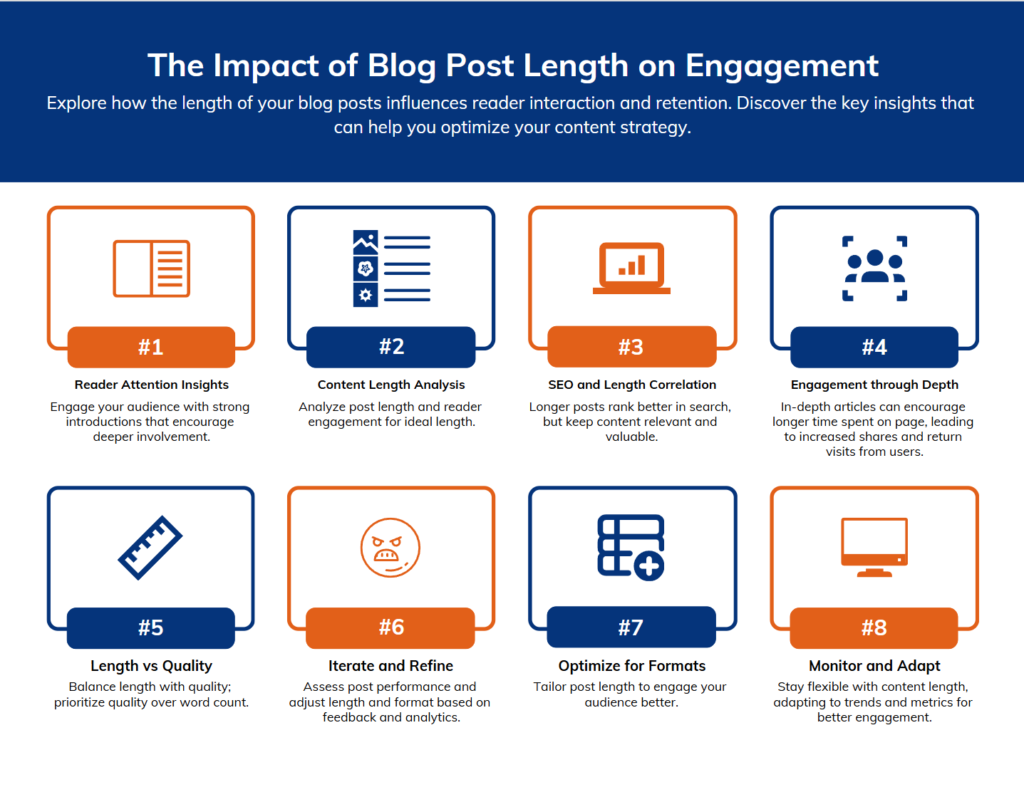
    Visuals like charts, graphs, and infographics make your content more engaging and easier to understand. For example:

    • “Here’s a breakdown of how blog post length affects engagement:

    4. The Art of Transitions

    Transitions are the glue that holds your content together. Use phrases like:

    • “Now that we’ve covered X, let’s move on to Y.”

    Mastering the Conclusion

    The conclusion is your final opportunity to leave a lasting impression. Here’s how to do it right:

    1. The Psychology of Memorable Endings

    End with a thought-provoking question or statement that keeps readers thinking. For example:

    • “What’s one thing you can do today to make your blog posts more engaging?”

    2. Call-to-Action Optimization

    Your CTA should be clear and compelling. For example:

    • “Ready to take your blog to the next level? Start by implementing these strategies today.”

    3. The Echo Effect

    Reinforce your key points to ensure they stick. For example:

    • “Remember, a great blog post starts with a captivating introduction, delivers value in the body, and ends with a powerful conclusion.”

    Advanced SEO and Distribution Strategies

    Finally, let’s talk about SEO and distribution. Even the best content won’t perform if no one sees it.

    1. Understanding Search Intent Patterns

    Align your content with what users are searching for. For example:

    • If someone searches for “how to write a blog post,” they’re likely looking for a step-by-step guide.

    2. Content Distribution Mathematics

    Use data to optimize your distribution strategy. For example:

    • Focus on platforms where your audience spends the most time.

    3. Viral Coefficients and Content Spread

    Encourage sharing by making your content highly shareable. For example:

    Include social sharing buttons and create content that sparks conversation.

    The Architecture of Engaging Body Content: The Science of Captivating Readers

    Picture your mind as a river. Sometimes it flows smoothly, carrying thoughts effortlessly downstream. Other times it encounters obstacles, creating turbulence that disrupts the journey. This metaphor perfectly captures the essence of what we’re about to explore: how to create content that guides readers into a state of effortless engagement, where time seems to disappear and understanding flows naturally.

    The Psychological Flow State: Understanding the Reader’s Mind

    The Science Behind Flow

    Mihaly Csikszentmihalyi, the psychologist who first identified the flow state, described it as a condition of complete immersion and focus. When applied to reading, this state occurs when readers are so engaged that they lose track of time and their surroundings. Think about the last time you were so absorbed in a book that you missed your subway stop – that’s the flow state we aim to create.

    Creating Conditions for Flow in Written Content

    To understand how to create flow in writing, we must first understand its prerequisites:

    The Challenge-Skill Balance: Content must be complex enough to maintain interest but not so difficult that it overwhelms. Consider how a video game progressively increases in difficulty – your content should follow a similar principle of graduated complexity.

    For example, when explaining a complex topic like artificial intelligence, you might structure your progression like this:

    First Level: “Artificial intelligence is like teaching a computer to make decisions.”
    Second Level: “These decisions are based on patterns the computer learns from data.”
    Third Level: “The computer uses mathematical models called neural networks to identify these patterns.”
    Fourth Level: “These neural networks are inspired by how human brain cells communicate.”

    Clear Goals and Immediate Feedback: Each section of your content should have a clear purpose, and readers should feel they’re making progress. This creates a sense of achievement that maintains engagement.

    The Flow Architecture Framework

    To consistently create flow-inducing content, consider these structural elements:

    Cognitive Stepping Stones: Place “mini-conclusions” throughout your text. These serve as rest points where readers can consolidate their understanding before moving forward. For instance:

    “Now that we understand how neural networks process information, let’s explore why this matters for everyday applications.”

    Progressive Disclosure: Reveal information in layers, each building upon the last. Think of it as slowly zooming out from a close-up photo to reveal the bigger picture.

    Rhythm and Pacing: Alternate between complex ideas and simpler explanations. This creates a natural rhythm that prevents cognitive fatigue.

    Advanced Storytelling Techniques: The Art of Narrative Flow

    The Hero’s Journey in Blog Writing

    Even technical or educational content can benefit from storytelling structures. Consider how the classic hero’s journey can be adapted for blog writing:

    The Call to Adventure (Introduction): Present a problem or challenge that resonates with readers.
    “Every content creator faces a moment when they realize traditional writing advice isn’t enough.”

    The Mentor (Your Expertise): Position your insights as the guide that will help readers overcome their challenges.
    “After analyzing thousands of high-performing articles, we’ve discovered patterns that consistently create engagement.”

    The Journey (Main Content): Present your solutions as a series of discoveries or revelations.
    “The first breakthrough came when we noticed successful writers weren’t just sharing information – they were creating experiences.”

    The Return (Conclusion): Show how readers can apply their new knowledge to transform their own work.
    “Armed with these insights, you’re ready to transform your content from mere information into engaging experiences.”

    Advanced Narrative Techniques

    Nested Loops: Start several story threads and resolve them in reverse order. This creates multiple open loops that keep readers engaged until resolution. For example:

    Open Loop 1: “The most successful blog post I ever wrote began with a failure…”
    Open Loop 2: “This failure taught me three crucial lessons…”
    Open Loop 3: “The first lesson changed everything I thought I knew about writing…”
    [Resolve Loop 3]
    [Resolve Loop 2]
    [Resolve Loop 1]

    Pattern Breaks: Intentionally disrupt expected patterns to maintain attention. Just as music uses unexpected chord progressions to maintain interest, your writing can use pattern breaks to keep readers engaged:

    Pattern: “First, we’ll examine X. Then, we’ll explore Y. Finally…”
    Pattern Break: “But here’s where everything you think you know about Z gets turned upside down…”

    The Architecture of Engagement

    Creating engaging body content is like designing a building where every room leads naturally to the next, each space serves a purpose, and the overall experience creates a sense of journey and discovery. Here’s how to achieve this:

    Structural Integrity: Every paragraph should serve one of three purposes:

    • Building understanding (providing new information)
    • Creating connections (linking concepts)
    • Facilitating reflection (allowing processing time)

    Flow Dynamics: Use varying sentence lengths and structures to create rhythm. Short sentences create punch. Longer sentences, with their more complex structures and carefully placed clauses, can carry readers through more nuanced ideas, creating a sense of momentum that pulls them forward.

    Transitional Elements: Create smooth transitions between ideas using:

    Conceptual Bridges: “This principle of progressive complexity doesn’t just apply to writing – it’s also crucial in…”

    Question Bridges: “But what happens when we apply these concepts to real-world situations?”

    Preview Bridges: “Understanding this foundation will be crucial when we explore…”

    The Psychology of Information Processing

    To maintain engagement throughout your content, consider how the human brain processes information:

    Chunking: Group related ideas into digestible sections. The brain naturally looks for patterns and relationships, so help it by creating clear categorical distinctions.

    Cognitive Rest Points: Insert brief summaries or reflection prompts after complex sections. These act as mental breathing spaces where readers can consolidate their understanding.

    Progressive Complexity: Layer information like a pyramid, with each level building on the previous one. Start with foundational concepts and gradually introduce more complex ideas.

    Creating Memorable Content

    For content to be truly engaging, it must also be memorable. Here’s how to achieve this:

    Concrete Examples: Transform abstract concepts into tangible illustrations. Instead of just explaining a principle, show how it works in real life.

    Emotional Anchors: Connect information to emotional experiences or relatable situations. The brain remembers emotional connections better than raw facts.

    Pattern Recognition: Help readers identify recurring themes and principles. The brain is naturally drawn to patterns, and recognizing them creates satisfaction and aids memory retention.

    The Future of Content Architecture

    As we move further into the digital age, the principles of engaging content continue to evolve. Yet the fundamental truth remains: human psychology drives engagement. Understanding and working with these psychological principles – rather than against them – is the key to creating content that not only captures attention but maintains it throughout the reader’s journey.

    Remember, the goal isn’t just to keep readers on the page – it’s to create an experience that transforms them, leaving them better informed and equipped than when they started. When we achieve this, we’ve created something truly valuable: content that serves both our readers and our purpose as content creators.


  • Mastering the First Impression: How to Hook, Engage, and Leave a Lasting Impact

    Mastering the First Impression: How to Hook, Engage, and Leave a Lasting Impact

    In today’s fast-paced digital world, where attention spans are shrinking and competition for engagement is fierce, the ability to make a strong first impression is more important than ever. Whether you’re writing a blog post, delivering a presentation, or crafting a social media update, the first few seconds are your only chance to capture your audience’s attention and convince them to stay.

    This guide will walk you through the art and science of creating impactful introductions, delivering informative and cohesive content, and closing with a lasting impression that inspires action. Let’s dive in.


    The Power of First Impressions: Why They Matter

    Research shows that it takes just 50 milliseconds (0.05 seconds) for users to form an opinion about your content. In that blink of an eye, they decide whether to stay or leave. This makes your introduction not just important—it’s critical.

    A well-crafted opening does three things:

    1. Captures Attention: Grabs the reader’s interest immediately.
    2. Establishes Relevance: Shows the reader why the content matters to them.
    3. Hints at Value: Teases the benefits they’ll gain by continuing to read.

    For example, consider this opening:
    “Did you know that 55% of visitors spend less than 15 seconds on a webpage? In a world where attention is the most valuable currency, your introduction is your only chance to make it count.”

    This approach combines a surprising statistic with a relatable challenge, instantly drawing the reader in.


    Crafting Engaging Introductions: Strategies That Work

    Here are proven techniques to hook your audience from the start:

    1. Ask a Thought-Provoking Question
      Questions spark curiosity and encourage readers to think. For example:
      “What if you could double your blog’s engagement with just one simple change?”
    2. Share a Surprising Statistic or Fact
      Data grabs attention and adds credibility. For instance:
      “According to a Harvard study, people form first impressions in just 7 seconds—and those impressions are often lasting.”
    3. Tell a Relatable Story or Anecdote
      Stories humanize your content and create an emotional connection. Example:
      “When I published my first blog post, I was shocked to see a 90% bounce rate. That’s when I realized the power of a strong introduction.”
    4. Use a Bold Statement or Controversial Idea
      Bold claims provoke curiosity and debate. For example:
      “Most blog posts fail before they even begin—here’s how to avoid that fate.”

    Once you’ve hooked your reader, provide a brief roadmap of what they’ll learn. This sets expectations and keeps them engaged.


    Crafting Informative and Cohesive Body Content

    Once you’ve captured attention, it’s time to deliver on your promise. Here’s how to structure your content for maximum impact:

    1. Break It Down into Clear Sections
      Use descriptive subheadings to guide readers through your content. For example:
      • Why First Impressions Matter
      • The Science Behind Attention Spans
      • 5 Strategies for Crafting Irresistible Introductions
      Subheadings make your content skimmable and help readers find the information they need quickly.
    2. Support Your Points with Evidence
      Back up your claims with data, research, or real-world examples. For instance:
      “A study by Nielsen Norman Group found that users read only 20-28% of the text on a webpage. This highlights the importance of concise, impactful writing.”
    3. Use Relatable Examples and Analogies
      Analogies simplify complex ideas and make them more memorable. For example:
      “Think of your introduction as the trailer for a movie. If it doesn’t grab attention, no one will stay for the main feature.”
    4. Maintain a Logical Flow
      Each section should build on the previous one. Use transition phrases like:
      • “Now that we’ve covered X, let’s explore Y.”
      • “Building on this idea, the next step is…”
      This creates a seamless reading experience and keeps your audience engaged.

    Powerful Closures: Leaving a Lasting Impression

    Your conclusion is your final opportunity to reinforce your message and inspire action. A strong closing should:

    1. Summarize Key Takeaways
      Recap the main points in a concise, memorable way. For example:
      “To master the art of first impressions, remember these three steps: hook your audience with a compelling opening, deliver value through structured content, and close with a call to action.”
    2. Offer Actionable Advice
      Give readers a clear next step they can implement immediately. For instance:
      “Start by revising the introduction of your latest blog post using one of the strategies we discussed today.”
    3. Encourage Engagement
      Invite readers to share their thoughts or experiences. Example:
      “Which of these strategies resonated most with you? Let me know in the comments below!”
    4. End with a Thought-Provoking Question or Statement
      Leave your audience thinking long after they’ve finished reading. For example:
      “In a world where attention is scarce, what will you do to make your content unforgettable?”

    The Takeaway: First Impressions Are Everything

    Mastering the art of the first impression isn’t just about writing better introductions—it’s about understanding your audience, delivering value, and creating a connection that lasts. By following the strategies outlined in this guide, you can transform your content into a powerful tool for engagement and impact.

    So, the next time you sit down to write, ask yourself: How can I make this unforgettable? The answer lies in your ability to hook, engage, and leave a lasting impression.


    Now it’s your turn:
    What’s your go-to strategy for crafting compelling introductions? Share your tips and experiences in the comments below!

  • Welcome to Smart Professional Content: The Start of Our Journey

    Welcome to Smart Professional Content: The Start of Our Journey

    We are excited to announce the launch of Smart Professional Content! This marks the beginning of an exciting chapter as we set out to provide businesses, entrepreneurs, and organisations with exceptional content and professional documentation services.

    Our mission is straightforward: to help our clients communicate clearly and professionally through tailored content that connects with their audience. From engaging website copy to impactful PowerPoint presentations and standout recruitment materials, we are here to deliver solutions that combine precision, creativity, and expertise.

    As we embark on this journey, we are driven by a passion for helping businesses tell their stories, enhance their processes, and achieve their goals. We believe that exceptional content is the foundation of meaningful connections, and we are proud to support our clients every step of the way.

    We look forward to growing, learning, and sharing insights as we move forward. Thank you for being part of this exciting adventure—we can’t wait to see where this journey takes us!

    Let’s create something exceptional together.